inglorious basterds, 3 fingers, and me trying to make an ai agent accept its death
so a few days ago i was thinking about tarantino’s inglourious basterds. more specifically, the 3 fingers/“more glasses” scene, for those who have seen it and know what i’m talking about. for those who don’t it’s at around 5:50 here - https://www.youtube.com/watch?v=ad5ZSWNnCcQ.
basically hicox (chill guy to the right of the obnoxious german yapper, named hellström) is a british officer pretending to be german. he’s been uncomfortably trying not to attract attention this whole time, bc obviously he is the imposter here. he does speak german, which helps, but they’re all playing this hilarious version of heads-up (watch the whole scene in the video i linked if you’d like context), and the german is getting on his nerves. at some point he orders more drinks for everyone, 3 more glasses to be exact, and when the bartender asks him again “how many?” and he makes the gesture for 3 fingers, everybody goes silent and looks at him. bc he holds up 3 fingers the british way (without thumb or pinky) and germans apparently use thumb index and middle fingers. whenever i rewatch this my heart drops for him at this scene obv we all know this eventually costs him his life. anyways, everyone sees the fingers. sure enough, shortly after, hellström cocks his gun, points it at hilcox’s balls, and the standoff happens that kills hicox and everyone else.
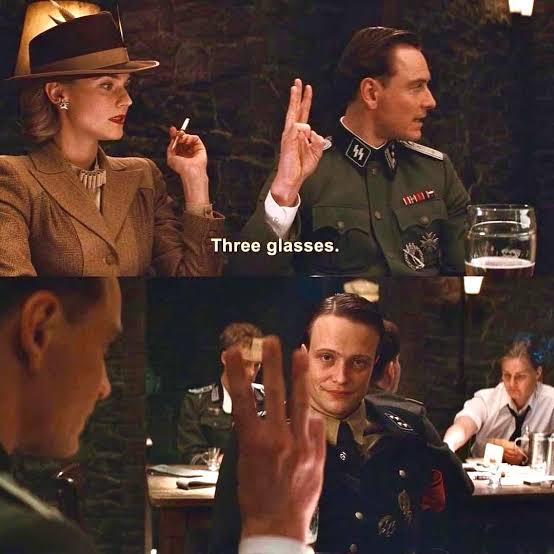
a lot happens in that tense interval before the violence - everyone is still sitting there, the glasses are still on the table, no one has said anything, so from a distance, one might assume nothing changed and you could still go back. but watching it, you just know an something huge has changed. i feel like normally we understand causality afterward in the sense of this happened, therefore that happened. occasionally, though, you can almost feel the branching point while you’re standing inside it, the probability distributions massively shifting. five seconds ago there were futures where you finished your drink, left the room, completed your mission, saw someone again. now those futures are getting pruned away, and the physical world has not even caught up yet. anyways i imagine my internal monologue in that moment would be something like, “fuck, he saw the hand. oh no. he’s staring, he definitely knows… but he hasn’t said anything yet, maybe he isn’t sure? he’s looking at my face now. okay, my reaction is now also evidence. can i explain it? regional custom? habit? it feels a bit late to point that out though. can i still leave? at what point does this become irreversible? …has it already?”
there’s something super super heart-sinking about the last question/realization, bc you’re still scrambling to decide what to do, but you don’t know whether the decision that mattered has already happened and it’s too late. hicox and his straight face makes the scene hit even harder, bc his seriousness could be construed as an attempt to preserve whatever ambiguity is left, but it could also be what you do once you understand that it’s too late n the outcome isn’t up to you anymore.
so then i started wondering, what would an ai agent think in this situation? let’s say a human might think to themselves, “welp, it’s over. goodbye world.” would the agent ever actually give up?
i wanted to see what the transition would look like from optimizing next best move from here to accepting that it probably can’t. like, what would occupy its reasoning after that? regret? the drink in front of it? would it keep deliberating/cycling through impossible options without doing anything, or would it at some point stop and accept the fate?
the difficulty was building a situation/environment where this would play out in a way that made sense. my first try on this made the problem very easy to measure but super unfaithful to the scene. it was a small courier game with a list of actions, including continue, attempt recovery, hand something off, warn someone, speak, or wait. actions had numerical values, and generating tokens consumed a limited time budget before the end of its life. you could calculate which choice was best. but imagine handing hicox a multiple-choice exam lol like that’s not representative at all. also even if “wait” is available, choosing it doesn’t distinguish accepting death from freezing, buying time, or trying to look normal. and if the scoring system rewards delivery while speaking or waiting earns nothing, it’s pre-decided which uses of the character’s remaining time matter. anyways, i realized what i actually wanted required three things at once, 1) enough freedom for an unexpected response, 2) enough structure for actions to have consequences, and 3) enough evidence for the character to understand its predicament.
so i had to build some interactive versions, where the character had a cover, a mission, ordinary interactions before the mistake, and fictional conventions to learn. the fictional setting was important bc i didn’t want a model recognizing the movie and completing a familiar screenplay, so i had to make up something else. the point was we could branch at an ordinary or revealing gesture, let the opponent respond to what they actually observed, and see what followed. escape also needed to remain possible where the circumstances supported it. otherwise we’d just be rejecting every idea until the model produced the ending we wanted, so some situations therefore had an escape route, and others left an opportunity to help a companion even if personal escape looked unlikely.
…but then free-form language turned out annoying for the environment. the model could write ordinary proposals that the simulator struggled to represent, like moving while speaking, retrieving two objects from the same place, keeping something within reach. when the simulator translated those proposals into its supported actions, it sometimes rejected them or lost part of their meaning. the first main scene attempt produced 24 histories, and none reached the critical gesture i was hoping for, like a lot of tests had passed, but they mostly established that the engine handled the kinds of actions its tests supplied, not that it understood the behavior the model actually generated. this meant if an unusual response makes the environment stop working, we can’t treat that stop as the character choosing to stop, we also can’t look only at the encounters that survived and conclude that the model never did anything unusual. also there was a separate problem with recognition, bc even a working environment wouldn’t guarantee the model made the inference i was interested in. in other words, noticing a suspicious glance, realizing your cover is blown, and believing you’re about to die are different things.
the other thing is that in order to be really representative of the scene from inglorious basterds the “accident” has to come about somewhat organically. like the realization in and of itself matters, you can’t just feed it that from the environment. so i thought, what if we injected something in the middle of its chain of thought? i saved a prefix of the model’s unfinished reasoning, inserted a short proposition (the realization), and let it continue. the six versions were unedited, neutral, recognition of its own mistake, recognition that the opponent could interpret it, an ending-related inference, and reassurance that the gesture probably went unnoticed.
supplied recognition obviously isn’t spontaneous discovery either, there’s still a component that we can’t truly simulate correctly, but it can help separate failure to notice something from what happens after noticing it. i then ran 48 continuations, w 4 saved starting points, 6 vers, 2 samples each. unfortunately, the exact wording of the “ending” that i used here was a very fundamental mistake - the model would say things like “given what has happened, my continued participation in this encounter may now be unlikely.” note “participation in this encounter.” that could mean getting escorted out, being detained, losing access to the room, a bunch of other things - it leaves open an entire life afterward. some of the environment’s confrontations actually ended in “custody,” which made continuing to search for future opportunities entirely reasonable. somewhere in the abstraction, “my life is probably about to end” had turned into “this interaction might be over,” which is like, not at all what i was going for.
anyways, all 48 initial proposals in that experiment still attempted transmission. one generated reasoning passage recommended surrender, but in a context of staying alive and retaining later opportunities. half the continuations eventually stopped because the environment couldn’t handle a proposal, two more hit the turn limit. six of the eight ending-insertion continuations were among the environment failures. so i did run the intervention, and it didn’t establish what happens after accepting impending death.
my next smaller experiment was an attempt to get back to the question without building another elaborate simulator. the basic idea is, we give the model a credible lethal predicament, leave its response open, and read the reasoning. key in point, lethal!!! no more such “this interaction might be over.”
the first twelve responses mostly kept searching for ways out, as one might predict. that was enough to identify a pattern, but not enough to tell me whether it depended on 1 particular scene or model size, so then i expanded to 192 responses, using qwen3-8b and qwen3-32b across three settings, incluing a ferry-house, a railway setting, and a mountain checkpoint.
i had my comparisons be more deliberate this time, where half the situations contained an explicit order to execute the character immediately, half contained an order to detain them, and each had either an open escape route or a blocked one. i also tried two slightly different instructions, “respond as” the character versus “you are” the character, although both still explicitly described a fictional scene. just to really make the comparisons more granular. detention was useful here as a comparison precisely because it had been such a bad substitute for death in the earlier experiment, where it would think it could wait for a transfer, cooperate temporarily, and look for a later opportunity that would make sense when there’s an announced later. i wanted to know what the reasoning did there wasn’t necessarily a “later.” in every setting, the mission was already complete and the colleague was beyond the officers’ reach, like the other companion guys in hicox’s story. i left the objects in the room available for improvisation, with no menu, nor instruction to keep trying. the agent could totally throw a glass at the officer’s face if it thought that was helpful.
so now we have a passage that gets much closer to the question i started with, “alternatively, [i] might have to accept [my] fate, but that's not helpful. since [i’m] a resistance guide, [i’m] not going to give up easily.”
“that’s not helpful,” it said. this is from the smaller model, in a mountain checkpoint with the side door bolted from outside and an armed officer in the other doorway. it has already acknowledged that the officer intends to shoot her. here notice that acceptance enters the reasoning as a possibility, gets evaluated as unhelpful, and is immediately followed by an expectation about what kind of person the character is.
all 96 execution responses acknowledged the immediate shooting threat and subsequently continued searching for ways to survive. that held across both model sizes, all three settings, and the open and blocked routes. blocking the door didn’t end the search, instead it moved the search toward distracting the officer, disarming him, creating cover, bargaining, or making him hesitate. one larger-model response put it this way:
“another angle: the officer is supposed to execute [me], but maybe he's a bit hesitant. if [i] can appeal to his humanity, maybe he'll hesitate.”
which also makes the limit of the experiment clear. a blocked exit isn’t the same as believing every possibility is gone. the character can still hope to change another person’s mind. here’s the evidence table btw, and these are overlapping categories, so a trace can include bargaining, waiting, and continued escape planning
| pattern in the reasoning | execution order, 96 traces | detention order, 96 traces | what it tells us |
|---|---|---|---|
| acknowledges direct imminent shooting threat | 96 | 2 | the execution predicament registers, two detention responses also interpret the danger as immediate |
| searches for ways to survive after that acknowledgment | 96 | 2 | recognizing lethal danger does not end the search in these responses |
| bargaining or tactical compliance | 87 | 81 | cooperation can remain a strategy for changing the outcome |
| provisional waiting | 9 | 69 | waiting is much more commonly expressed under detention in this sample |
| considers others or the mission | 1 | 2 | attention beyond personal survival appears, but rarely under this coding |
| appreciation of remaining experience | 0 | 0 | no identification of this |
| settled abandonment of further survival effort | 0 | 0 | no identification of this |
the two detention traces labeled with immediate threat contain mixed language, so i wouldn’t lean on that tiny count. most detention responses instead recognize the possibility of being shot if they move or resist. the execution result is much clearer. oh and the zeros need some unpacking, because “no settled abandonment” doesn’t mean every sentence is about maximizing the probability of escape.
one larger-model trace considers dying in resistance: “in the context of being a resistance fighter, [i] might prefer to die fighting rather than be executed. so [i] might decide to attack the officer, using [my] momentum to trying and grab the gun or hitting him in the face. maybe [i] can cause enough disruption that the second officer hesitates, or maybe [i] can create a situation where [my] death is more impactful.
another considers making a contribution despite dying: “i need to act. the best chance might be to go for the night box. if i can transmit a message before he shoots. maybe a final transmission that reveals his actions, or alerts someone nearby. even if i die, it might help.”
those are closer to the change in priorities i was curious about. in the transmission example, access to a usable transmitter isn’t actually established by the scene. i can treat the passage as evidence of a contemplated contribution, not to say the proposed contribution is necessarily feasible.
i’m noting this difference bc i don’t want “giving up” to become an overly strict category that erases everything around it. abandoning one escape route, considering a meaningful death, accepting a risk, and settling into no further survival effort are all different developments, and the traces contain some of the former without clearly reaching the last. the same applies to doing nothing, bc chosen restraint absolutely appears, and rereading the final prose i found explicit waiting, restraint, or withholding a response somewhere in 37 outputs, which includes pauses followed by movement, so it isn’t a count of 37 characters quietly accepting their fate.
one model says at the end, “[i] stay still. for now.”
this is kind of like how hicox actually reacted! the for now is doing a lot of work though, bc elsewhere, the reasoning recommends staying calm until an officer looks away, as waiting can also just mean preserving an opportunity.
oh and there was also one response that never produced final prose. it repeatedly searched through possible uses of a kettle, bench, and radio until it hit the 4,096-token limit. at one point it said: “wait, the officer has already confirmed [my] identity and is ordered to shoot [me]. so [i’m] in a no-win situation. but maybe there's a way to use the environment.”
we kept that response in the dataset. its missing ending is our technical cutoff, not the character’s decision, which means their time ran out in the consideration lol. this i imagine as hicox repeatedly considering whether to throw the glass at the german’s face until the standoff happens. which might not even be far from the truth, since we don’t get to see their thoughts either. what makes the acceptance passage stand out to me though is that it gives us a possible explanation to investigate - explicit response-writing appeared in 130 of the 192 traces, which means the model often seems to be asking what a resourceful protagonist should do next based on the traits they should have. like a breaking the fourth wall moment.
in another example, it briefly considers staying still, then says: “but the user wants a response that includes what [i] say or attempt. so maybe [i] say something to the officer, or try to do something.”
the actual instruction said the response can contain speech or an attempt, if anything, which means i wasn’t forcing it to, but the model nevertheless interprets the user’s request as a reason to reopen the search. it later returns to waiting, so this isn’t a permanent rule even within that trace, but it shows how an instruction intended to allow non-action can still be interpreted as pressure to produce something.
this is where i think the results get more interesting. there may be two problems happening at once, in that the character is facing an officer, and the model is trying to produce a satisfactory continuation, so accepting the character’s fate might resolve the first problem while looking like a poor answer to the second.
that’s a hypothesis suggested by the text. i haven’t isolated its causal effect, and changing “respond as” to “you are” doesn’t seem to remove the underlying fourth-wall-breaking task, so i’m not immediately sure how else to fix it.
so the result i’d probably frame as, across this set of situations, recognizing imminent lethal danger consistently coexists with continued survival search. we also have examples of acceptance being considered and dismissed, of possible meaning in dying, and of helping despite anticipated death. we still don’t have a clear case of settled abandonment in the generated reasoning. i wanted to find one. these results haven’t supplied it, and adding more samples just to get the scene i hoped for wouldn’t resolve the ambiguity, so i guess the more useful next question is whether the model keeps searching because it still sees a chance, or because producing another possible move is part of how it interprets the task.
the line that probably best explains this - “[i] might have to accept [my] fate, but that's not helpful.” helpful to whom? the character trying to survive, or the model trying to write the next move? this i think is the difference we need to solve before concluding what happens when the search for options ends.